BAUHAUS STUDY (AI, 2026)
KANDINSKY — THE COSMIC YEARS
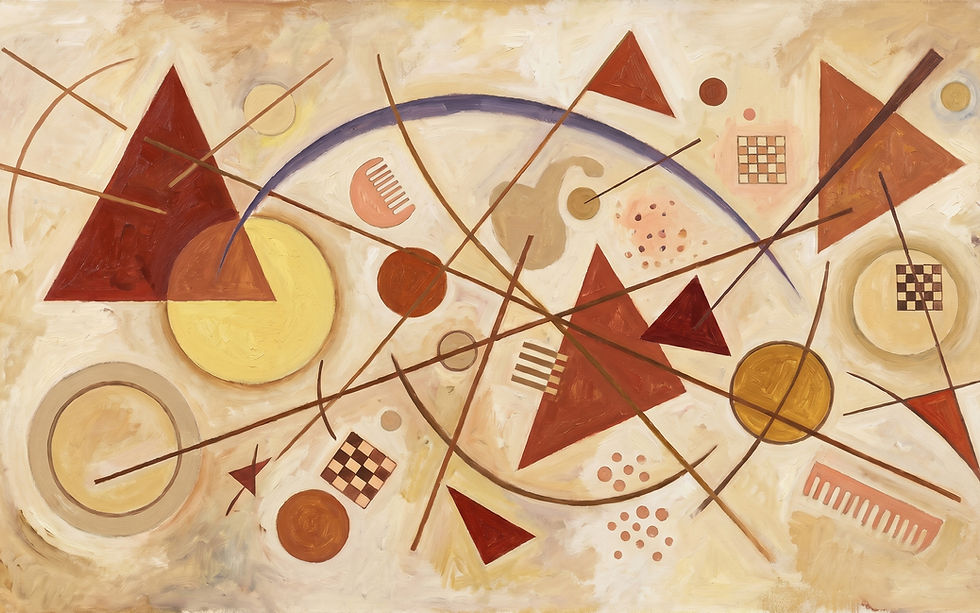
Wassily Kandinsky joined the Bauhaus in 1922 as a teacher and immediately changed the school’s visual vocabulary. He brought with him a fully developed theory of color and form — circles meant one thing, triangles another, yellow was sharp, blue was deep — and the Weimar years (1922–1925) became his laboratory for applying this theory in monumental compositions. The three works gathered here trace that cosmic period: a composition built around a central disk, a complex orchestration of circles and triangles in dynamic relation, and a quieter composition where biomorphic forms float against geometric grids. Note: Kandinsky’s historical palette relied on primary blue, red, and yellow; this study translates those primaries into the warm-palette range while preserving the cosmic geometry.
Artificial Intelligence
SOFT GEOMETRY
GRIDS
A more tranquil composition by Kandinsky: gentle biomorphic forms float against a deliberately designed grid background.
AROUND THE CENTER
DISK
A single central disk anchors the composition — a warm sun-form around which smaller geometric elements arrange themselves. Kandinsky believed the circle held cosmic significance, the most peaceful and most complete of forms. Here it becomes the gravitational center for triangles, lines, and small biomorphic accents.


BAUHAUS STUDY (AI, 2026)
KLEE — THE WHISPERED ALPHABET
Where Kandinsky composed orchestrally, Paul Klee whispered. His small Bauhaus paintings reach for the cosmic but assemble it from a private alphabet of signs — houses, arrows, fish, moons, an eye, an arm — drawn with the absolute formal control of a master draftsman. Every mark placed, every color weighed. The Bauhaus theorist became its poet. The three works gathered here trace that whispered alphabet: a lyrical composition built from drawn signs floating against warm ground, a magic square of colored cells in mathematical balance and a single small creature emerging from warm fields. Klee’s Bauhaus palette was already quite warm — many works needed only minor adjustment to fit the warm-klammer.
Artificial Intelligence
A SMALL EMERGENCE
CREATURE
From warm swathes of colour, a single tiny creature emerges – a bird, a fish or a sort of Klee hybrid that exists only in his paintings. During his time at the Bauhaus, Klee created dozens of these small animal portraits, each of which reflects a very personal friendship between the painter and the imaginary creature.
A MAGIC GRID
SQUARE
A grid of small colored cells in mathematical balance — Klee’s Magic Squares, the abstract paintings he made by carefully weighing every adjacent color against its neighbor. The composition resembles a quilt or a window of stained warmth: nothing happens, but every cell is alive with its own intention.
SIGNS AND ARROWS
ALPHABET
A lyrical composition built from Klee’s private alphabet of signs — small houses, arrows, fish, a single eye, a curling arm, a stylized moon — arranged on a warm atmospheric ground as if floating in the same space as words on a page. The composition rewards close looking. Every sign means something, even when the meaning cannot be named. Each small drawing is its own small monument.


BAUHAUS STUDY (AI, 2026)
MOHOLY-NAGY — THE CONSTRUCTED FUTURE
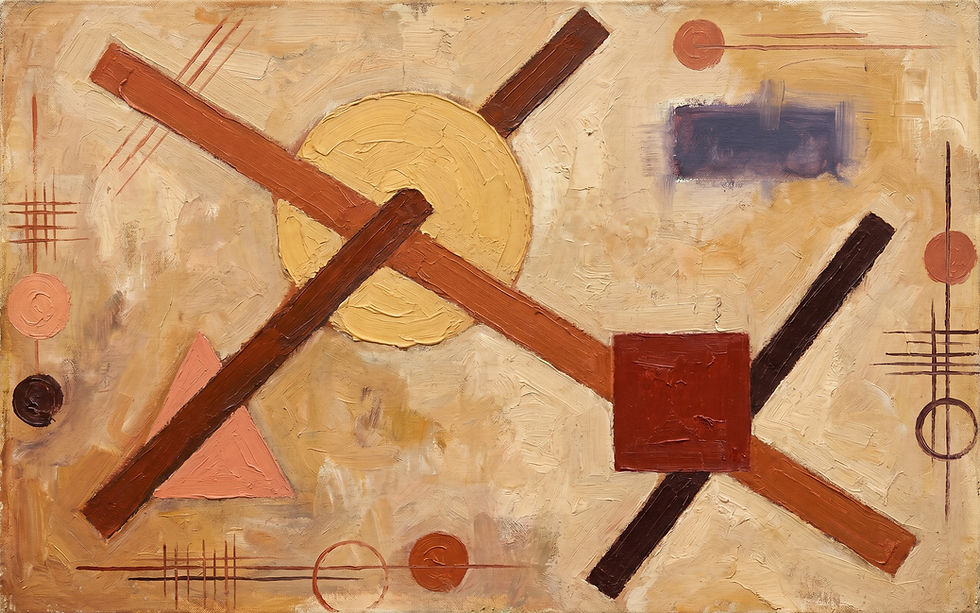
László Moholy-Nagy pushed the Bauhaus furthest from painting itself. The Hungarian constructivist saw the future not in the easel but in photography, film, industrial design, and light. His Bauhaus compositions feel engineered rather than painted — overlapping transparent planes, crossing diagonal axes, the clean precision of stacked glass or layered film. The two works captioned here, framed by a third image that needs no commentary, trace that constructed vision: a composition of crossing diagonal axes anchored by single geometric solids, and a complex orchestration of overlapping transparent planes. Moholy’s historical palette used cool primary blues alongside warm reds; this study translates the full primary range into warm earth while preserving the constructivist precision.
Artificial Intelligence
OVERLAPPING TRANSPARENT FIELDS
PLANES
A complex Moholy-Nagy orchestration: overlapping transparent planes layered across the canvas like stacked glass, each layer translucent so the layers below show through. The square composition rewards close looking. Every transparent overlap is a separate small zone of warm complementary tension. Every edge, every corner, every translucent crossing is its own small monument of constructivist precision.
CROSSING DIAGONALS
AXES
A constructivist composition built around crossing diagonal axes — long warm lines slicing across the canvas at meeting angles, anchored by single geometric solids where they intersect. Moholy-Nagy used these crossing structures as the foundation of his whole visual language. The painting as built object, made of pure direction and weight.


BAUHAUS STUDY (AI, 2026)
SCHLEMMER — THE TYPOLOGY OF MAN
Oskar Schlemmer treated the human body as the Bauhaus’s most important building. He taught the Vorkurs there for a decade, designed the Triadic Ballet, and painted figures as if they were architectural elements — abstracted, archetypal, suspended in shallow geometric space. Where Klee whispered and Kandinsky orchestrated, Schlemmer measured. The three works gathered here trace that measured humanism: a single archetypal figure in frontal stance, a single dancer in Triadic Ballet costume and a group of figures ascending and descending a Bauhaus stair.
Artificial Intelligence
ASCENDING THE BAUHAUS
STAIR
A group of figures ascends and descends a wide architectural stair — Schlemmer’s most famous composition, painted as a kind of farewell when the Bauhaus was forced from Dessau in 1932. The figures abstracted to essential type — students going up and down, the school itself rising in geometric warmth around them. Each figure rewards close looking: every body simplified differently, every gesture an architectural decision.
TRIADIC BALLET
DANCER
A single dancer in Triadic Ballet costume — Schlemmer’s most famous design, where the human body was reshaped by geometric costume into a moving sculpture. The dancer stands frontal in shallow warm space, body wrapped in geometric volumes, the costume both clothing and architecture. The dance reduced to a single still figure of warm geometric volume.
A SINGLE ARCHETYPE
FIGURE
A single archetypal figure stands frontal in shallow warm space — body simplified to its essential planes, head a smooth ovoid, no facial features beyond the most abstract indication of eyes. Schlemmer painted these archetypal figures throughout his Bauhaus years, treating them as architectural studies of the human form.


BAUHAUS STUDY (AI, 2026)
KANDINSKY — THE STRICT YEARS
When the Bauhaus moved from Weimar to Dessau in 1925, Kandinsky’s painting changed. The early cosmic exuberance gave way to a stricter geometry — biomorphic forms tightened into precise circles and lozenges, the compositions became less crowded, the color more deliberate. These late Bauhaus years (1929–1933) produced what some consider his most finished paintings: works of severe internal logic in which every element has earned its place. The three works gathered here trace that strict period: a composition of precisely measured circles in deep warm space, a quiet arrangement of intersecting geometric solids, and a late composition where biomorphic shapes return as small organic forms within strict architecture.
Artificial Intelligence
RETURN OF BIOMORPHIC LIFE
ORGANIC
A late work by Kandinsky in which biomorphic forms – kidney-shaped figures, amoeba-like curves – appear time and again as small organic accents.
PRECISELY MEASURED
CIRCLES
A composition of precisely measured circles in deep warm space — Kandinsky’s late Bauhaus period at its most distilled. The circles each in a different warm tone, each in a deliberate relation to every other, the whole composition reading like a quiet mathematical proposition.


