IMPRESSIONISM STUDY (AI, 2026)
MONET — A SUMMER BY THE SEA
In the summer of 1870 Monet traveled with his wife Camille to the Normandy coast — first to Trouville, then westward to Étretat. It was their honeymoon, and it opened a new register in his work: the modern seaside as a subject equal to any landscape he had painted before. The three works gathered here trace this summer in three voices — the fashionable beach with its parasols and hotels, the working coast with its fishermen and chalk cliffs, and the quiet figure of Camille alone on the sand.
Artificial Intelligence
A NEW SUBJECT
DISCOVERY
For a long time, the French coast was merely a place of work. Trouville changed all that in the 1860s, and Monet captured the moment when the town transformed into a holiday resort.
ON HONEYMOON
TOGETHER
Throughout the Normandy summer, Camille was Monet's constant companion — newly his wife, soon to be the mother of his son Jean. She appears in his paintings of these months not as a formal portrait but as a presence woven into the beach scenes around her. Even when she is not the subject, she is nearby — a parasol on the sand, a figure in white at the edge of the frame. The grand subjects of cliff and sea were painted with her always close.


IMPRESSIONISM STUDY (AI, 2026)
RENOIR — THE WARMTH OF COMPANY
Where Monet turned to atmosphere and the sea, Renoir turned to people. Through the 1870s and early 1880s, he painted the human form bathed in warm afternoon light — in cafés and dance halls, at country tables, alone with a book or in a parlour at the keyboard. The three works gathered here trace a single arc: a quiet hour of reverie, a Sunday dance in the open air, and a soft duet of two figures at a piano. Light on skin remained, for Renoir, the impressionist subject above all.
Artificial Intelligence
AN INWARD HOUR
REVERIE
In the rooms where his patrons' daughters waited between visits, Renoir found a quieter subject. A young woman in afternoon light, a book half-attended, a small fan loose in her lap — the moment when company has stepped away and the face turns toward its own thoughts. Skin, fabric, and idle hands carry the entire weight of the picture.
AT THE KEYBOARD
DUET
In a Paris parlour, two young women lean together over an open piano — one playing, one watching the music. Renoir gives them the warm interior glow he gave his outdoor scenes: a single lamp, a vase of flowers, the polished wood of the instrument. What looks like a simple domestic moment is actually his great subject — two faces caught in shared attention, with all the softness of skin reading as paint.
A SUMMER SUNDAY
DANCE
On weekends Renoir followed his friends to the riverside village of Bougival, where dancing went on under wooden lanterns into the long summer evening. He painted a single couple from very close — the woman's dress mid-swirl, the man's straw boater tipped down. Around them, the dance floor and the village dissolve into warm light. The composition holds enough quiet incident — a turned glance, a flowering branch, a glass left on a bench — that the eye can travel it slowly, finding new detail at every distance.


IMPRESSIONISM STUDY (AI, 2026)
PISSARRO — A YEAR IN THE COUNTRY
No impressionist remained closer to rural life than Camille Pissarro. While his peers turned increasingly toward Paris and its boulevards, Pissarro stayed loyal to fields, hedgerows, and the slow daily rhythms of villages — Pontoise, Louveciennes, Éragny. The two works captioned here, framed by a third image that needs no commentary, trace that quieter conviction: a country road at the end of the day, and a market square in the warm hour after morning sun.
Artificial Intelligence
MORNING IN PONTOISE
MARKET
Pissarro followed the weekly markets of his region for thirty years — the same square, the same stalls, the same farmers and customers from a town he knew by heart. This square format compresses the whole scene to its essentials: a knot of figures around a vegetable stall, baskets on the ground, a shop awning, the warm stone of the village behind. The longer one looks, the more incident emerges — a gesture, a bonnet, a child at the edge of the crowd.
AT GOLDEN HOUR
ROAD
A country road runs from the foreground into the distance, lined with thinning poplars and a low stone wall. A single peasant figure walks home, her shadow long behind her. Pissarro painted these end-of-day moments throughout his career — the working road as it empties out, the light still warm but already pulling back from the fields. Nothing happens, and everything happens.


IMPRESSIONISM STUDY (AI, 2026)
MORISOT — A QUIETER LIGHT
While her male colleagues painted Paris boulevards and country leisure, Berthe Morisot turned her gaze inward — toward the women, children, and gardens of her own daily world. Married to Édouard Manet's brother and trained in defiance of nineteenth-century expectations, she became the first woman to exhibit with the impressionists and one of the movement's most radical stylists. The three works gathered here trace the full arc of her vision: a young woman in the private hour before the world begins, an infant watched over in its cradle, and a daughter reaching for cherries in the summer garden.
Artificial Intelligence
STEPPING AWAY
Hair
A second moment in the same hour, a few minutes later. The young woman has turned partly away from the mirror and gathers her loose hair behind her neck with both hands — eyes lowered, absorbed in the small mechanical task. A peignoir falls open over her chemise, a vase of warm flowers stands on the dressing table behind her. Morisot built the composition out of several quiet vignettes: the inward face, the raised arms, the open robe, the reflected fragment in the mirror, the still-life on the table. Each one rewards close looking.
IN THE ORCHARD
CHERRIES
In a summer orchard, a small girl on a wooden ladder reaches up into the laden branches, while a younger child in a straw hat watches from below. Morisot painted childhood not as a posed subject but as an action observed — concentration, balance, the easy collaboration of siblings or cousins. The vertical composition rises with the ladder into the canopy, and the warm afternoon light filters down through cherries and leaves into the soft pale of two summer dresses.
A LAST DETAIL
Mirror
A second moment in the same hour, a few minutes later. The young woman has turned partly away from the mirror and gathers her loose hair behind her neck with both hands — eyes lowered, absorbed in the small mechanical task. A peignoir falls open over her chemise, a vase of warm flowers stands on the dressing table behind her. Morisot built the composition out of several quiet vignettes: the inward face, the raised arms, the open robe, the reflected fragment in the mirror, the still-life on the table. Each one rewards close looking.


IMPRESSIONISM STUDY (AI, 2026)
MONET — THE GOLDEN HOUR
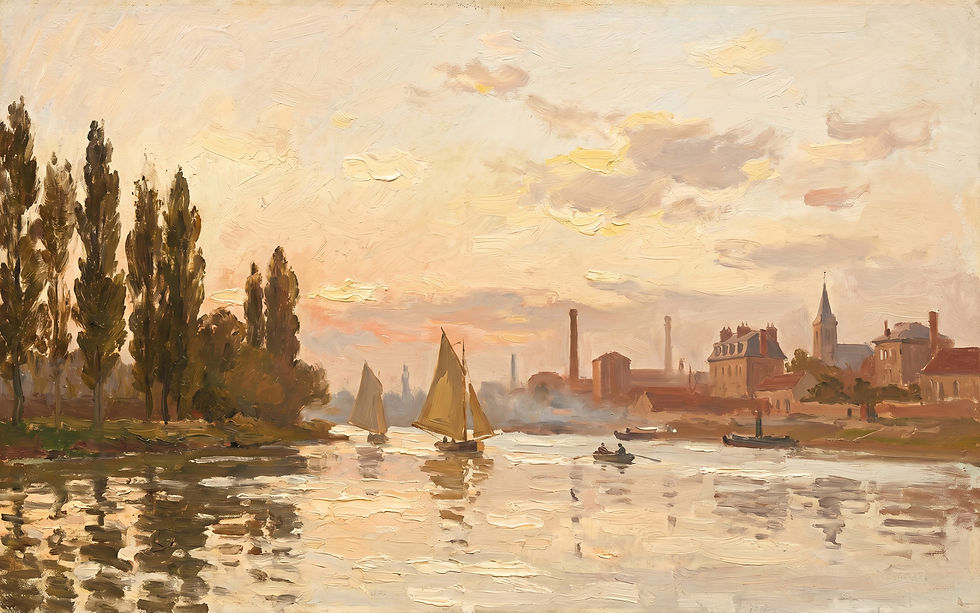
Throughout his life, Monet returned to the moment when daylight begins to soften — the slow turning of afternoon into evening, when warm tones suffuse water, sky, and earth alike. The three works gathered here trace this lifelong fascination across three of his great motifs: a Seine afternoon at Argenteuil under apricot skies, a haystack dissolving into morning mist at Giverny, and the water lily pond in suspended gold. Painted over four decades, they share a single quiet pursuit — the search for a light that is neither morning nor night, but the threshold between presence and memory.
Artificial Intelligence
A LIFELONG RETURN
THRESHOLD
From the industrial Seine of his youth to the water-lily pond of his later years, Monet kept returning to that hour.
A WAY OF SEEING
ATMOSPHERE
The golden hour gave Monet what no studio could: a light that softened edges, unified tones, and made every object participate in a single warm atmosphere. Form dissolved into air, water into reflection, painting itself into meditation on light.